


Page 49 - Журнал «Русский Берег» #10-2022
P. 49
RUSSIAN COAST | № 2/9 2022  ТРАДИЦИИ | TRADITIONS


                  of 8‑9 m2. Dark red and dark   the Koran in Arabic. On a small rug, the   prayer mats to huge salon carpets. One of
            ENG
                  blue are considered traditional   craftswoman created a real picture. Floor   the largest carpets with an area of 468 m2
          for Tashpinar carpets. These colors provide a   carpets were also woven. The main motive   and a weight of 3 tons covers the floor in the
          decorative effect between the borders and   for them is a medallion, and it should   hall of the Yildiz Palace complex in Istanbul.
          medallions. Intermediate shades ‑ red, plum,   traditionally be present in the pattern of this   It was woven in 1897 on the occasion of the
          gray‑blue, black. You can often find henna   type. Now Ladik carpets are completely   visit of the German Emperor Wilhelm II and
          and cinnamon colors.               handmade only in one cooperative and   covers the entire floor of the hall. According
            All Tashpinar carpets are decorated with   several households. As before, the masters   to the composition, there are two types of
          floral motifs arranged in geometric order. The   use 13 color schemes. The predominant   Hereke carpets ‑ wool with cotton and “silk on
          figure, although highly stylized, is given little   colors are black, red, dark green, dark blue,   silk”. Silk hereks are the thinnest carpets in the
          space. The usual motif is a composition with   brown, and beige. In accordance with the   world ‑ they contain more than a million knots
          deer antlers and leaves. The main drawing is   requirements of the drawing, light shades are   per square meter. Despite the fact that the
          medallions with figures of eagles spreading   also added to the model ‑ white, dark pink,   threads are very thin, because of the weaving
          their wings. In Tashpinar carpets, the surface   light pink, light green, light blue, and yellow.   technology, the products are durable.
          is filled according to a scheme consisting   Modern Ladik carpets are floor‑standing,   The Hereke method allows the possibility
          of borders, a central pattern, and corners.   large sizes, designed for living rooms and   of using a second duck. In this technology,
          Even if the type of carpet changes, the   salons. Synthetic paints are used, and only   a technique with Gerdes knots and double
          arrangement of patterns cannot be changed.  a part of the coating is created manually.   knots is used, which increases the strength of
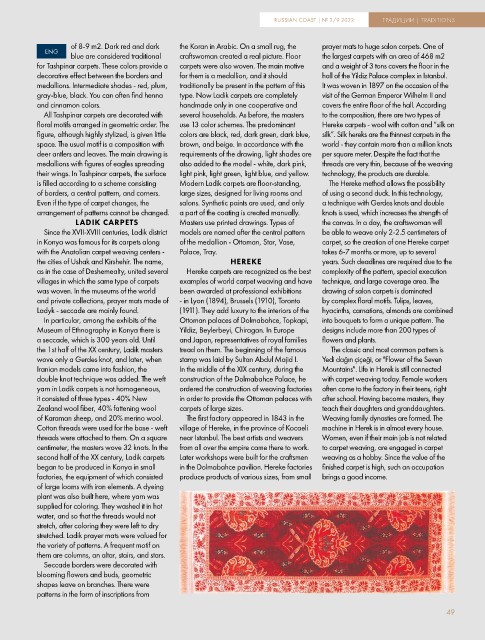
                    LADIK CARPETS            Masters use printed drawings. Types of   the canvas. In a day, the craftswoman will
            Since the XVII‑XVIII centuries, Ladik district   models are named after the central pattern   be able to weave only 2‑2.5 centimeters of
          in Konya was famous for its carpets along   of the medallion ‑ Ottoman, Star, Vase,   carpet, so the creation of one Hereke carpet
          with the Anatolian carpet weaving centers ‑   Palace, Tray.           takes 6‑7 months or more, up to several
          the cities of Ushak and Kirshehir. The name,    HEREKE                years. Such deadlines are required due to the
          as in the case of Deshemealty, united several   Hereke carpets are recognized as the best   complexity of the pattern, special execution
          villages in which the same type of carpets   examples of world carpet weaving and have   technique, and large coverage area. The
          was woven. In the museums of the world   been awarded at professional exhibitions   drawing of salon carpets is dominated
          and private collections, prayer mats made of   ‑ in Lyon (1894), Brussels (1910), Toronto   by complex floral motifs. Tulips, leaves,
          Ladyk ‑ seccade are mainly found.   (1911). They add luxury to the interiors of the   hyacinths, carnations, almonds are combined
            In particular, among the exhibits of the   Ottoman palaces of Dolmabahce, Topkapi,   into bouquets to form a unique pattern. The
          Museum of Ethnography in Konya there is   Yildiz, Beylerbeyi, Chiragan. In Europe   designs include more than 200 types of
          a seccade, which is 300 years old. Until   and Japan, representatives of royal families   flowers and plants.
          the 1st half of the XX century, Ladik masters   tread on them. The beginning of the famous    The classic and most common pattern is
          wove only a Gerdes knot, and later, when   stamp was laid by Sultan Abdul Majid I.   Yedi dağın çiçeği, or "Flower of the Seven
          Iranian models came into fashion, the   In the middle of the XIX century, during the   Mountains". Life in Herek is still connected
          double knot technique was added. The weft   construction of the Dolmabahce Palace, he   with carpet weaving today. Female workers
          yarn in Ladik carpets is not homogeneous,   ordered the construction of weaving factories   often come to the factory in their teens, right
          it consisted of three types ‑ 40% New   in order to provide the Ottoman palaces with   after school. Having become masters, they
          Zealand wool fiber, 40% fattening wool   carpets of large sizes.      teach their daughters and granddaughters.
          of Karaman sheep, and 20% merino wool.   The first factory appeared in 1843 in the   Weaving family dynasties are formed. The
          Cotton threads were used for the base ‑ weft   village of Hereke, in the province of Kocaeli   machine in Herek is in almost every house.
          threads were attached to them. On a square   near Istanbul. The best artists and weavers   Women, even if their main job is not related
          centimeter, the masters wove 32 knots. In the   from all over the empire came there to work.   to carpet weaving, are engaged in carpet
          second half of the XX century, Ladik carpets   Later workshops were built for the craftsmen   weaving as a hobby. Since the value of the
          began to be produced in Konya in small   in the Dolmabahce pavilion. Hereke factories   finished carpet is high, such an occupation
          factories, the equipment of which consisted   produce products of various sizes, from small   brings a good income.
          of large looms with iron elements. A dyeing
          plant was also built here, where yarn was
          supplied for coloring. They washed it in hot
          water, and so that the threads would not
          stretch, after coloring they were left to dry
          stretched. Ladik prayer mats were valued for
          the variety of patterns. A frequent motif on
          them are columns, an altar, stairs, and stars.
            Seccade borders were decorated with
          blooming flowers and buds, geometric
          shapes leave on branches. There were
          patterns in the form of inscriptions from

                                                                                                               49

