


Page 33 - Журнал «Русский Берег» #10-2022
P. 33
RUSSIAN COAST | № 2/9 2022  ПРОГНОЗЫ | PREDICTION


                     wind, fire, and air. Astrology   2‑ İshak, müneccim, 14 akça  the date of the beginning of the month of
              ENG    in their spells was present in   3‑ Sinan, müneccim, 10 akça  Ramadan and abuse of authority.
                     the form of luminaries ‑ the   (approx. müneccim ‑ fortune teller,   In the second half of the XVI century.
          favor of the Moon and the Sun promised   astrologer; akça ‑ Turkish coin)  the observatory was at the disposal of the
          a rich harvest and fertility of livestock. A   Under Sultan Murad IV, astrologers took   capital's stargazers. It did not last long ‑
          frequent motif of drawings on shamanic   pride of place in parades and official exits   a few years later Sultan Murad III gave
          tambourines is the sickle of the waning or   of the ruler ‑ another confirmation of respect   the order to shoot the building from ship
          growing Moon as a symbol of the cyclicity   and trust in their occupation.  guns. Researchers call the dissatisfaction
          of life.                             An important part of the work of   of the people of Istanbul Pichina. The fact
            Among the few ancient treatises, the work   scientists was the calculation of "Eşref   is that the astronomer and mathematician
          of the soothsayer Al‑Konevi “Ahkâm‑ç Sâl‑i   saati" ‑ a favorable time for the start of   Takiyuddin, observing the sky with the help
          Türkân”, written in Sivas in the XIV century,   events. Astrologers determined the hours of   of instruments, saw a comet in the sky,
          has come down to us. It describes a 12‑year   laying the foundation for the construction   a “tailed star”. He declared it a sign of
          calendar, where the years are named after   of mosques, the day the army went on a   prosperity and happiness for the empire.
          animals. The roots of such a system are not   military campaign, the date of launching a   When the prophecy did not come true and
          connected with the Chinese tradition, but   new ship. The schedule of palace events,   an epidemic struck Istanbul, the inhabitants
          with the beliefs of the ancient Turkic peoples.   such as the wedding of the Sultan and his   considered the tower the cause of their
          The annual astro‑calendar, familiar to us,   associates or the issuance of a seal to the   misfortunes. The new observatory appeared
          with 12 constellations of the zodiac from   Grand Vizier, was drawn up after a careful   in the Turkish capital only in 1868 and
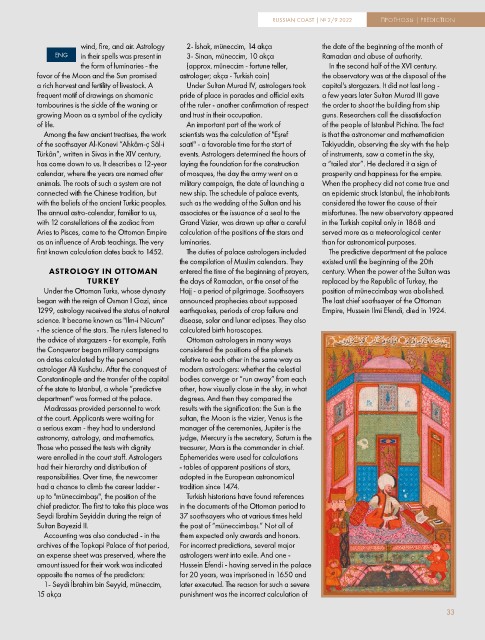
          Aries to Pisces, came to the Ottoman Empire   calculation of the positions of the stars and   served more as a meteorological center
          as an influence of Arab teachings. The very   luminaries.             than for astronomical purposes.
          first known calculation dates back to 1452.  The duties of palace astrologers included   The predictive department at the palace
                                             the compilation of Muslim calendars. They   existed until the beginning of the 20th
             ASTROLOGY IN OTTOMAN            entered the time of the beginning of prayers,   century. When the power of the Sultan was
                      TURKEY                 the days of Ramadan, or the onset of the   replaced by the Republic of Turkey, the
            Under the Ottoman Turks, whose dynasty   Hajj ‑ a period of pilgrimage. Soothsayers   position of müneccimbaşı was abolished.
          began with the reign of Osman I Gazi, since   announced prophecies about supposed   The last chief soothsayer of the Ottoman
          1299, astrology received the status of natural  earthquakes, periods of crop failure and   Empire, Hussein Ilmi Efendi, died in 1924.
          science. It became known as "Ilm‑i Nücum"   disease, solar and lunar eclipses. They also
          ‑ the science of the stars. The rulers listened to   calculated birth horoscopes.
          the advice of stargazers ‑ for example, Fatih   Ottoman astrologers in many ways
          the Conqueror began military campaigns   considered the positions of the planets
          on dates calculated by the personal   relative to each other in the same way as
          astrologer Ali Kushchu. After the conquest of   modern astrologers: whether the celestial
          Constantinople and the transfer of the capital   bodies converge or “run away” from each
          of the state to Istanbul, a whole “predictive   other, how visually close in the sky, in what
          department" was formed at the palace.  degrees. And then they compared the
            Madrassas provided personnel to work   results with the signification: the Sun is the
          at the court. Applicants were waiting for   sultan, the Moon is the vizier, Venus is the
          a serious exam ‑ they had to understand   manager of the ceremonies, Jupiter is the
          astronomy, astrology, and mathematics.   judge, Mercury is the secretary, Saturn is the
          Those who passed the tests with dignity   treasurer, Mars is the commander in chief.
          were enrolled in the court staff. Astrologers   Ephemerides were used for calculations
          had their hierarchy and distribution of   ‑ tables of apparent positions of stars,
          responsibilities. Over time, the newcomer   adopted in the European astronomical
          had a chance to climb the career ladder ‑   tradition since 1474.
          up to "müneccimbaşı", the position of the   Turkish historians have found references
          chief predictor. The first to take this place was   in the documents of the Ottoman period to
          Seydi Ibrahim Seyiddin during the reign of   37 soothsayers who at various times held
          Sultan Bayezid II.                 the post of “müneccimbaşı.” Not all of
            Accounting was also conducted ‑ in the   them expected only awards and honors.
          archives of the Topkapi Palace of that period,  For incorrect predictions, several major
          an expense sheet was preserved, where the   astrologers went into exile. And one ‑
          amount issued for their work was indicated   Hussein Efendi ‑ having served in the palace
          opposite the names of the predictors:  for 20 years, was imprisoned in 1650 and
            1‑ Seydi İbrahim bin Seyyid, müneccim,   later executed. The reason for such a severe
          15 akça                            punishment was the incorrect calculation of

                                                                                                               33

